
Before Propaganda Changes the World, It Changes You
Metacognition, Misinformation, and Your Responsibility to Protect Humanity

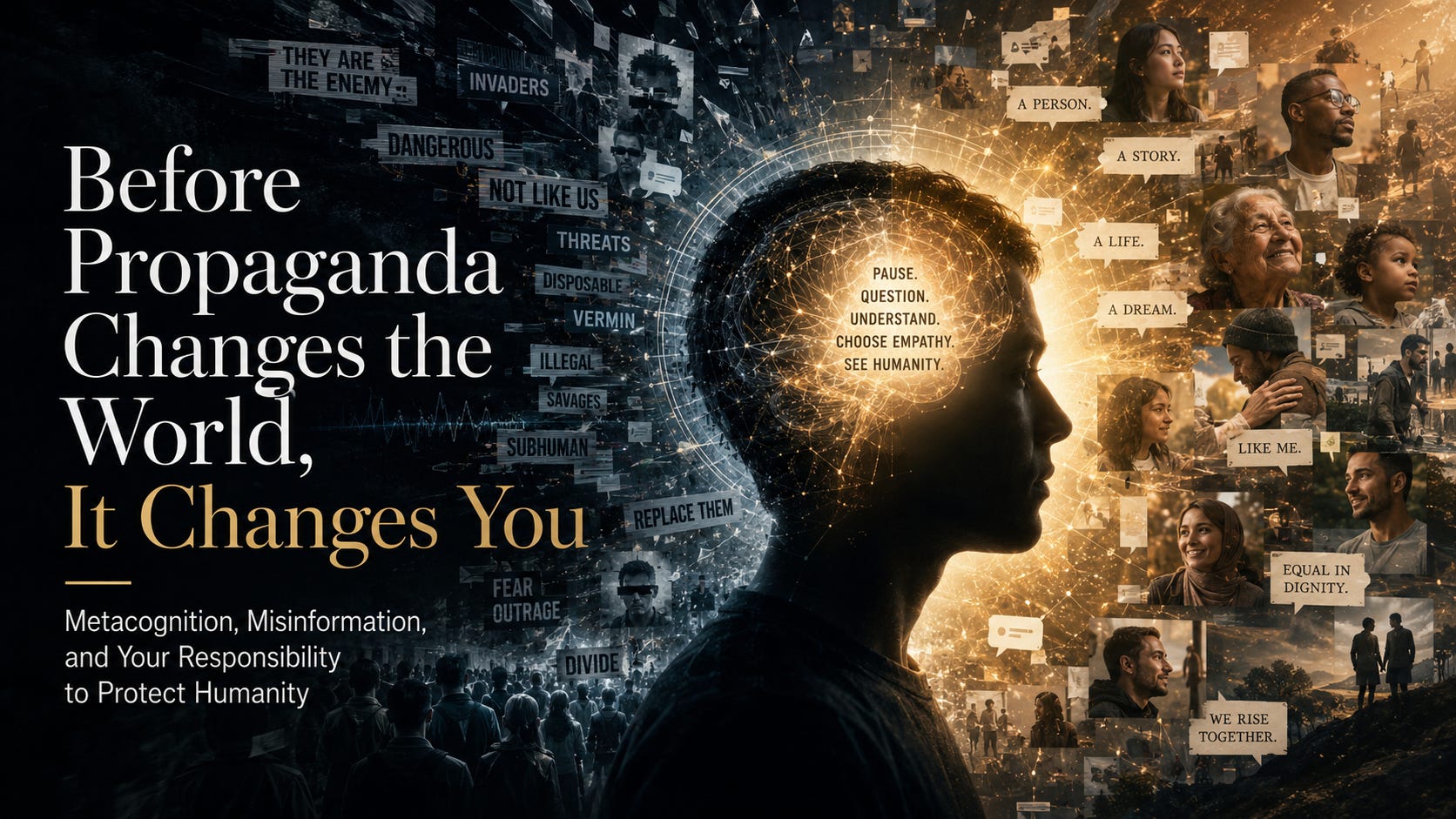
You may believe propaganda has not changed you.
You may reject openly racist language, oppose religious discrimination, support immigration, condemn violence against civilians, and consider yourself fair-minded. You may be educated, internationally experienced, culturally aware, and confident in your ability to distinguish fact from manipulation.
But propaganda rarely begins by asking you to abandon your values openly.
It begins more quietly.
It repeatedly shows you whom to fear.
It attaches danger to a religion, criminality to an immigrant, extremism to a protester, suspicion to a nationality, and collective guilt to a population. It tells you which victims are innocent, which victims are controversial, and which victims can be discussed only through the government, movement, or military force associated with them.
The message is repeated until the association becomes familiar.
Familiarity begins to feel like knowledge.
Knowledge begins to feel like certainty.
Then one day, the consequences appear somewhere that seems entirely unrelated to the news.
A résumé arrives.
The applicant has an Arab, Iranian, Pakistani, Chinese, African, Indigenous, or South Asian name. The employer does not consciously think, I intend to discriminate. Instead, a small hesitation appears.
Will this person fit in?
Will clients be comfortable?
Will communication be difficult?
Are they sufficiently professional?
Can they be trusted?
The employer may never recognize that these questions did not originate in the interview room. They may have been planted through years of headlines, political speeches, television panels, films, social-media clips, selective images, and repeated descriptions of people who share the applicant’s name, appearance, nationality, or faith.
That is how propaganda travels.
It moves from the screen into the nervous system, from the nervous system into judgment, and from judgment into another human being’s life.
It becomes the interview that is never offered.
The promotion that never arrives.
The apartment that is suddenly unavailable.
The refugee who is treated as an invader.
The Muslim employee who is regarded as potentially disloyal.
The Palestinian whose national identity is treated as an accusation.
The Iranian whose humanity disappears behind the word “regime.”
The civilian whose death is described as regrettable but strategically necessary.
Propaganda does not merely change what you believe.
It can change whom you recognize as fully human.
The War for Your Mind Is a War Against Humanity
Misinformation is usually understood as information that is false or inaccurate. Disinformation is false or misleading information spread deliberately. Propaganda can include both, but it does not always depend on an outright lie.
A report may contain individually accurate facts and still construct a profoundly misleading reality.
It can select one history and omit another.
It can repeatedly show the violence of one group while minimizing comparable or greater violence by another.
It can quote officials from a powerful government as authorities while treating the testimony of their victims as inherently questionable.
It can use active language when an official enemy acts and passive language when an ally kills.
It can describe one population through individual names, families, professions, and dreams while describing another only through statistics, security labels, and military terminology.
It can transform political convenience into moral truth.
This is why consuming more information does not necessarily make a person better informed.
The deeper question is whether we understand how information organizes our perception.
UNESCO defines media and information literacy as the ability to critically access, analyze, evaluate, and create content across different platforms. It identifies these abilities as essential for recognizing misinformation, discerning bias, resisting hate speech, and participating responsibly in public life.
Prestige Academy takes this responsibility one step further.
Information literacy asks:
Is this message credible?
Metacognition asks:
What is this message doing inside me?
Cultural Intelligence asks:
How might this message affect the way I interpret and treat people whose identity, history, or culture differs from my own?
Conscious leadership asks:
What harm may occur if I allow an unexamined association to become a decision?
These questions are inseparable.
Your Mind Is Not an Empty Container
Human beings do not receive each new story with a completely neutral mind.
Every message enters an existing network of memories, assumptions, emotions, loyalties, fears, and previously repeated claims.
This is why repetition is so powerful.
Psychological research on the illusory truth effect has found that repeated statements can feel more truthful because familiarity makes them easier for the mind to process. Importantly, repetition can influence perceived truth even when people possess knowledge that should help them recognize the statement as false.
This does not mean that every repeated statement is false.
It means repetition itself can create a feeling of credibility that is not the same as evidence.
When people are repeatedly shown stories connecting Muslims with terrorism, immigrants with crime, refugees with social collapse, Indigenous people with dependency, or foreign populations with security threats, the brain begins to retrieve these associations more easily.
Ease of retrieval can be mistaken for accuracy.
The next story then feels as though it confirms something already known.
But what appears to be confirmation may actually be accumulated exposure.
This is one of propaganda’s most effective achievements: it makes implanted assumptions feel self-generated.
You no longer experience the conclusion as something you were taught.
You experience it as common sense.
How Selective Coverage Manufactures Perceived Reality
Consider how violence involving Muslims has been presented in the United States.
A peer-reviewed study examined terrorist attacks committed in the United States between 2006 and 2015. It found that attacks involving Muslim perpetrators received, on average, 357 percent more media coverage than attacks involving non-Muslim perpetrators. The researchers controlled for factors including fatalities, target type, and whether an arrest occurred. They found that the perpetrator’s religion was a major predictor of the volume of coverage.
The importance of this finding goes far beyond the number of headlines.
When violence involving a Muslim perpetrator receives several times more exposure than comparable violence committed by someone else, audiences may begin to confuse the frequency of coverage with the frequency of occurrence.
A violent individual ceases to be treated as an individual.
The person becomes a representative of a faith followed by nearly two billion human beings.
Islam is placed on trial.
Muslims who did not know about, relationship with, or responsibility for the crime are expected to condemn it, explain it, or prove their distance from it.
By contrast, violence by a non-Muslim perpetrator is more often individualized. The discussion may focus on personal grievances, mental condition, family history, isolation, ideology, or access to weapons. The perpetrator’s entire religion or civilization is less likely to be summoned as a co-defendant.
The difference teaches the audience a pattern:
When a Muslim commits violence, the religion explains the person.
When someone else commits violence, the person explains the violence.
This is how exceptional conduct becomes collective identity.
No secret meeting of every journalist is required. No single editor needs to issue a universal instruction. The effect can emerge through institutional assumptions, commercial incentives, political framing, source dependence, audience expectations, and repetition across a system.
The outcome is nevertheless real.
A population is made to appear more dangerous than the available evidence justifies.
Organized Prejudice Has Infrastructure
Anti-Muslim hostility is often discussed as though it were merely a collection of spontaneous personal prejudices.
But narratives require production, funding, distribution, repetition, and institutional access.
A report produced by the Council on American-Islamic Relations and the Center for Race and Gender at the University of California, Berkeley identified 33 organizations it classified as part of an anti-Muslim network. According to the report, those organizations had access to at least US$205 million in total revenue between 2008 and 2013.
That figure must be described accurately. It does not mean that every dollar was spent directly on propaganda, nor does it establish that every criticism of Islam or a Muslim-majority government is Islamophobic.
It does establish that organized anti-Muslim messaging is not always a spontaneous reaction arising independently in millions of minds. It can be supported by well-funded organizations, political campaigns, advocacy networks, publications, commentators, training programs, lobbying activity, and media amplification.
The prejudice later experienced as personal intuition may have an institutional history.
A person thinks:
I simply have concerns.
But who selected those concerns?
Who repeated them?
Who supplied the images?
Who decided which isolated event would represent an entire global population?
Who benefited politically when fear was transformed into public support for surveillance, exclusion, immigration restrictions, military action, or discrimination?
Metacognition requires us to examine not only the message but the architecture that made the message feel natural.
The Human Consequences Do Not Remain on the Screen
In Canada, police-reported hate crimes targeting Muslims rose from 84 incidents in 2020 to 229 in 2024—nearly tripling over four years. Statistics Canada notes that these figures include incidents identified by police as confirmed or suspected hate crimes. They also represent only incidents that reached police attention and were recorded within the reporting system.
Statistics cannot tell us the complete story.
They cannot measure every person who removed a visible expression of faith because they felt unsafe.
Every child who became afraid that classmates would associate their family with violence.
Every employee who stayed silent about civilian suffering because they feared professional consequences.
Every woman who calculated whether wearing a hijab would affect an interview.
Every person who experienced hostility but concluded that reporting it would lead nowhere.
Nor does the rise in reported hate crime prove that one specific headline directly caused one specific act.
The point is not to claim a simple mechanical relationship.
The point is that information environments are not harmless.
Repeated dehumanizing narratives help establish the social conditions in which suspicion, exclusion, and hostility can appear reasonable to the people practising them.
Propaganda prepares the moral climate.
Others act within it.
When Propaganda Enters the Interview Room
The connection between public narrative and private decision is especially important for anyone exercising leadership.
A large Canadian résumé audit involved nearly 13,000 applications submitted to more than 3,000 job postings in Toronto and Montreal. The applications contained standardized qualifications while varying the apparent ethnic background of candidates’ names.
Applicants with Chinese, Indian, or Pakistani names were 28 percent less likely to receive an interview call than applicants with Anglo-Canadian names, even when the applicants had equivalent qualifications and entirely Canadian education and experience.
For every 100 calls received by applicants with Anglo names, similarly qualified applicants with Asian names received approximately 72.
The employers were not reviewing immigration status, foreign education, or unfamiliar work experience. The résumés were designed so that those explanations could not account for the difference.
The name itself activated a disadvantage.
Employers later interviewed by the researchers sometimes associated Asian names with possible language difficulties or strong accents—even though the résumés showed Canadian education and experience, and the employers possessed no direct evidence of a communication problem.
This is precisely where metacognition and Cultural Intelligence become leadership obligations.
A leader may sincerely oppose discrimination and still reproduce it.
Good intentions do not automatically reveal hidden associations.
A diversity statement does not neutralize years of social conditioning.
An organization may celebrate multiculturalism publicly while allowing unnamed impressions such as “fit,” “presence,” “professionalism,” “communication,” or “client comfort” to conceal culturally conditioned judgments.
The metacognitive leader asks:
Am I evaluating evidence—or reacting to familiarity?
Did this candidate demonstrate a weakness, or did their name cause me to imagine one?
Would I describe the same communication style differently if it came from someone who resembled the existing leadership team?
Am I calling this person “confident” and that person “aggressive”?
Am I treating one accent as sophisticated and another as evidence of limited competence?
Am I asking an immigrant to prove belonging while assuming that someone from the dominant group already belongs?
This is not about lowering standards.
It is about ensuring that the standards are real, relevant, and applied consistently.
Propaganda Exploits the “Us and Them” Reflex
The human mind is capable of empathy, reason, conscience, and extraordinary moral courage.
It is also vulnerable to fear, conformity, group loyalty, and the desire for belonging.
Propaganda exploits the speed of those reactions.
It tells the audience:
Your group is threatened.
Your way of life is disappearing.
Your jobs are being taken.
Your neighbourhood is becoming unsafe.
Your religion is under attack.
Your nation is being humiliated.
The people causing this harm do not think like you.
They do not belong.
Once the emotional boundary is established, contradictory evidence becomes harder to accept.
Information supporting the group’s narrative is welcomed quickly.
Information challenging it is subjected to higher standards, dismissed as biased, or treated as betrayal.
This is where intelligence can become a servant of propaganda rather than a defence against it.
An intelligent person may use considerable reasoning ability not to examine a belief, but to protect it.
They search for evidence selectively.
They explain away contradictions.
They reinterpret inconvenient facts.
They attack the character of the source.
They mistake their ability to defend a position for proof that the position is true.
Metacognition interrupts this process by asking:
Am I using my intelligence to investigate—or to rationalize what my group has already taught me to believe?
Identity Is Not Evidence
One of propaganda’s most dangerous strategies is replacing individual evidence with collective identity.
The immigrant is treated as a demographic threat.
The Muslim is treated as a security question.
The Palestinian name itself is treated as suspicious or degrading.
A Lebanese community is reduced to a political or military label that makes its destruction easier to excuse.
Iran’s people disappear behind the word “regime,” as though millions of civilians have no identities, families, political opinions, rights, or sovereignty separate from the state institutions Western governments oppose.
Jewish people are wrongly treated as collectively responsible for the conduct of the Israeli government.
Russian civilians are treated as extensions of the Kremlin.
Americans are treated as personally responsible for every action of Washington.
The categories change.
The mechanism does not.
Collective labelling removes the moral discipline of individual assessment.
It permits people to assign guilt without evidence and reduce compassion without admitting that they are doing so.
The ethical rule must remain consistent:
No human being inherits guilt from a government, military, political organization, religion, ethnicity, or nationality merely because someone else placed them in the same category.
Individuals remain responsible for their own conduct.
Governments remain responsible for theirs.
Armed organizations remain responsible for theirs.
Citizens may carry different degrees of responsibility depending on their knowledge, freedom, participation, power, and choices.
But identity alone is not evidence of guilt.
No Media Institution Deserves Automatic Trust
The answer to propaganda is not blind loyalty to mainstream media.
Nor is it blind loyalty to alternative media.
A corporate news organization may publish excellent investigative reporting while repeating institutional assumptions favourable to its government or owners.
A state-funded outlet may expose facts ignored by Western media while concealing misconduct by the state supporting it.
An independent journalist may perform courageous work with limited resources.
Another may circulate unverified claims because they flatter the audience’s worldview.
A social-media account may publish authentic evidence one day and fabricated material the next.
Prestige Academy’s position is therefore simple:
No mainstream, corporate, government-funded, partisan, independent, or social-media source deserves automatic trust.
Trust must be earned claim by claim.
The question is not:
Do I trust this institution?
The better questions are:
What is the precise claim?
What is the original source?
What evidence has been provided?
Has the evidence been independently corroborated?
What information has been omitted?
Does the headline accurately represent the underlying material?
Are fact, interpretation, allegation, and legal conclusion being distinguished?
Has the source corrected previous errors transparently?
What would this outlet likely emphasize or ignore if the identities of the parties were reversed?
Rejecting automatic trust is not cynicism.
Cynicism declares that everyone lies and truth cannot be known.
Metacognition insists that truth matters enough to require disciplined examination.
Exposure Is Not the Same as Responsibility
No one controls every message that reaches them.
You do not choose every headline displayed on your phone.
You do not design every algorithm.
You do not determine which government statement is repeated across hundreds of outlets.
You do not control the prejudices inherited from family, school, entertainment, politics, or earlier generations.
Exposure is often involuntary.
Responsibility begins with what happens next.
It is important to recognize that responsibility is graded.
The organization that knowingly manufactures a false narrative carries more responsibility than the person who encounters it unknowingly.
The financier carries more responsibility than the involuntary target.
The government official with access to intelligence carries more responsibility than the citizen denied reliable information.
The broadcaster reaching millions carries more responsibility than the private person speaking to one friend.
The employer deciding another person’s future carries more responsibility than someone experiencing a fleeting association but refusing to act upon it.
But once we know that manipulation is occurring, awareness creates an obligation.
We become responsible for whether we pause.
Whether we verify.
Whether we amplify.
Whether we correct ourselves.
Whether we allow inherited prejudice to become institutional action.
Whether we apply the same evidentiary and moral standards to allies, enemies, insiders, and outsiders.
Exposure may be involuntary.
Amplification is a decision.
PAUSE for Humanity
Research published in Nature found that many people care about accuracy but may share misleading information because their attention is focused on something else: emotion, political agreement, novelty, identity, or social reaction. In experiments and a field study, briefly directing attention toward accuracy improved the quality of information people subsequently chose to share.
That finding is both hopeful and demanding.
A pause can matter.
Prestige Academy’s PAUSE for Humanity framework is designed not merely to prevent intellectual error, but to protect human beings from the consequences of unexamined thinking.
P — Pause Before Emotion Becomes Judgment
Notice your first response.
Fear.
Anger.
Disgust.
Pride.
Humiliation.
Loyalty.
The satisfaction of seeing your existing belief confirmed.
An emotional response does not prove the information is false. It suggests your judgment may be more susceptible to manipulation.
Ask:
What is this message trying to make me feel before I examine what it is asking me to believe?
A — Audit the Association
Identify the person, identity, or population being connected to the threat.
Has an individual act been generalized to millions of people?
Has a religion been made responsible for a perpetrator?
Has a nationality been turned into a security category?
Has a civilian population been made interchangeable with a government or armed organization?
Ask:
Is this conclusion based on evidence about an individual—or an association attached to a group?
U — Unpack the Construction
Separate the verifiable claim from the emotional structure surrounding it.
Examine the headline, image, labels, music, repetition, anonymous officials, selective history, and missing context.
Notice whose suffering is shown in intimate detail and whose suffering is described impersonally.
Ask:
What was included, what was omitted, and how did those choices shape my conclusion?
S — Seek Independent Evidence
Do not search only for material confirming what you already believe.
Look for original documentation.
Compare reporting from sources with different ownership structures and political perspectives.
Distinguish allegation from verified fact.
Examine credible evidence challenging your preferred position.
Ask:
What evidence would genuinely cause me to revise my conclusion?
When the honest answer is “nothing,” you are no longer investigating.
You are protecting an identity.
E — Exercise Your Humanity
Before sharing, hiring, voting, condemning, excluding, or remaining silent, consider the human consequences.
Ask:
What may happen to another person if I accept this narrative and I am wrong?
Could it deny someone employment?
Could it make discrimination appear reasonable?
Could it normalize collective punishment?
Could it make civilian deaths easier to tolerate?
Could it transform an innocent person into a threat in someone else’s mind?
Would I accept the same reasoning if the person being described were my child, my family, my faith, or my community?
The Final Battlefield Is the Human Conscience
Propaganda succeeds when a human being disappears,
and only a category remains.
Immigrant.
Muslim.
Palestinian.
Iranian.
Lebanese.
Jewish.
Indigenous.
Refugee.
Protester.
Foreigner.
Enemy.
Extremist.
Collateral damage.
Metacognition restores the person behind the word.
It reminds us that no government owns our conscience.
No political party deserves our automatic loyalty.
No alliance should determine which civilians matter.
No celebrated leader should be trusted merely because they speak eloquently.
No media institution should be permitted to decide whose children are grievable and whose deaths are strategically acceptable.
No repeated label should relieve us of the duty to investigate.
The purpose of metacognition is not simply to make us more accurate thinkers.
It is to make us more difficult to recruit into another person’s dehumanization.
You are not responsible for every message placed before you.
You are responsible for examining what it is teaching you to fear.
You are responsible for noticing whom it is teaching you to disregard.
You are responsible for what you repeat.
You are responsible for the decisions you make when another person’s dignity, opportunity, safety, or life is affected.
Before propaganda changes a workplace, a government, a policy, or a country, it changes what ordinary people are willing to accept.
Before it changes the world, it changes you.
PAUSE—not only to protect your mind, but to protect the human being your unexamined mind may harm.