
The Hypocrisy Effect
How moral incoherence erodes trust, destabilizes the leader’s brain, and why ethical coherence is now a leadership imperative

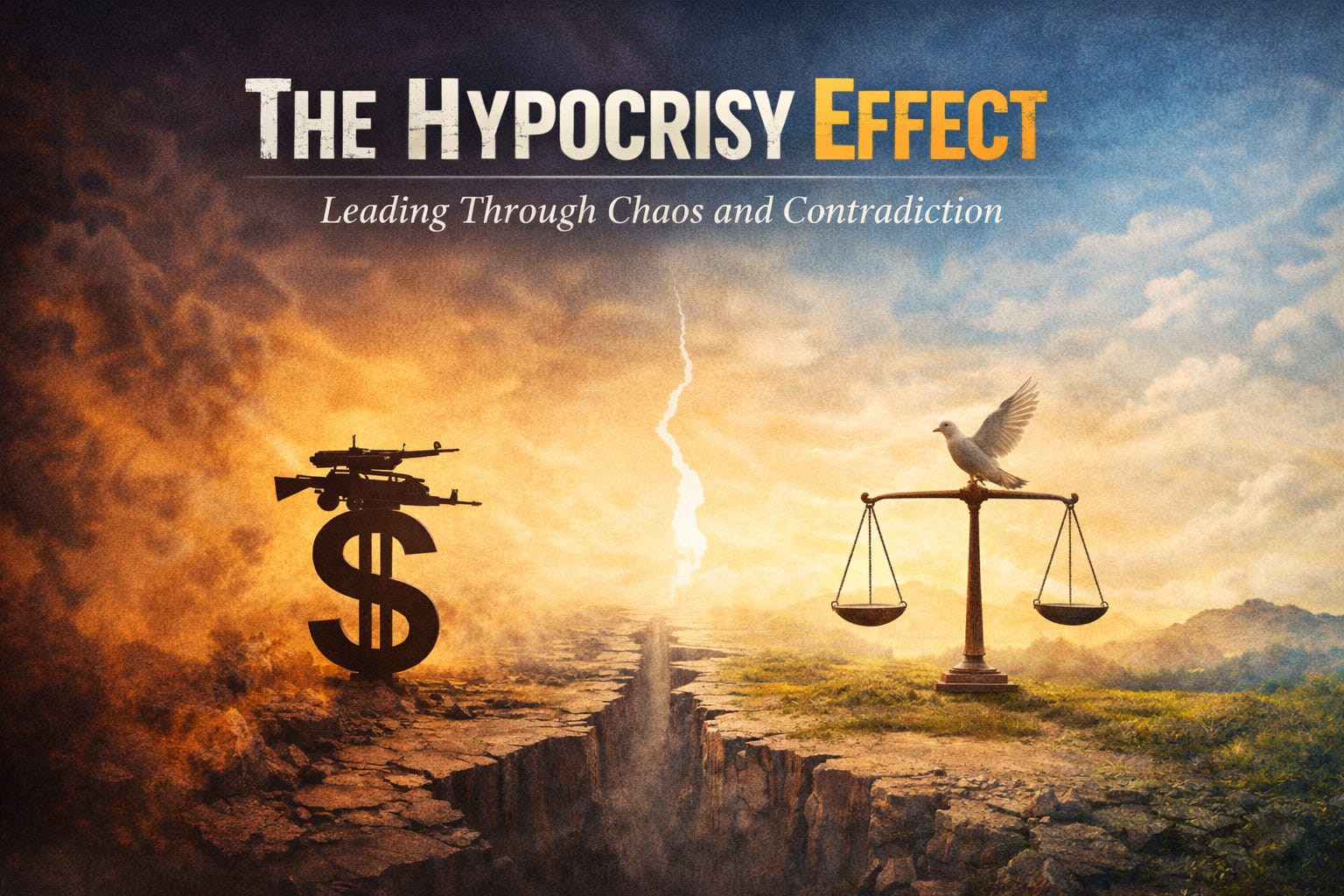
Over the past year, many leaders have felt something difficult to articulate. Beyond grief or anger, there is a more profound destabilization caused by watching public language drift further and further away from lived reality.
When leaders speak of values while enabling outcomes that contradict those values, the damage is not only political or economic. It is psychological. Hypocrisy at scale disrupts trust, deregulates the nervous system, and quietly erodes the human capacity to lead with clarity.
This article is an invitation to step beyond outrage and toward something more stabilizing and far more powerful: ethical coherence—as a leadership practice, a neurological anchor, and a pathway to repair.
1. Why hypocrisy impacts the nervous system before it reaches the intellect
Hypocrisy is not simply inconsistency. In leadership contexts, there is a persistent mismatch between declared principles and observable actions. The brain experiences this mismatch as a threat. When reality becomes unreliable, the nervous system shifts into protective modes: hypervigilance, emotional numbing, cynicism, or withdrawal.
This is not weakness or disengagement. It is a biological attempt to restore safety in an incoherent environment.
2. Escalation replaces diplomacy — and leadership clarity collapses
Economist Jeffrey Sachs has consistently warned that the abandonment of diplomacy in favour of escalation produces instability, economic strain, and long-term moral failure¹. When diplomacy disappears, threat becomes the operating system.
Leaders under threat do not think expansively. They narrow, simplify, and defend. Organizations and societies then mirror the same pattern: pressure replaces conversation, dominance replaces repair, and trust becomes collateral damage.
3. When profit becomes the only language, humans become expendable
Economist Richard Wolff has long argued that systems driven exclusively by profit inevitably externalize human costs². Once harm is framed as an acceptable trade-off, ethical sensitivity dulls.
In leadership cultures, this shows up as efficiency overriding dignity, performance masking suffering, and values becoming slogans rather than standards. Over time, leaders lose empathy stamina — not because they don’t care, but because the system rewards detachment.
4. Interests, power, and the moral tension leaders must hold
Political scientist John Mearsheimer reminds us that power systems often justify destructive actions through moral language that masks strategic interests³. The leadership challenge is not to deny this tension, but to learn to hold it consciously.
When leaders avoid ethical tension rather than confront it, hypocrisy becomes normalized. Silence is rebranded as professionalism, and discomfort is mislabelled as disloyalty. This is how moral incoherence spreads quietly through institutions.
5. Emotional intelligence begins where hypocrisy hurts
Psychologist Daniel Goleman identifies self-awareness as the foundation of emotional intelligence⁴. In times of moral contradiction, self-awareness becomes more than personal growth — it becomes a form of leadership hygiene.
Naming internal responses such as grief, anger, fear, or numbness is not indulgent. It is regulatory. What remains unnamed becomes reactivity, projection, or burnout disguised as resilience.
6. Integrity is alignment, not perfection
Researcher Brené Brown defines integrity as choosing courage over comfort and practicing values rather than merely professing them⁵. In an era where hypocrisy often masquerades as sophistication, integrity may look quiet and unspectacular.
It may sound like a boundary, a problematic question, a refusal to use dehumanizing language, or a decision that protects people even when it costs speed or approval.
7. Restoring coherence: the leader’s inner work
Former intelligence analyst Larry Johnson has cautioned that decisions detached from human consequence eventually undermine credibility and stability⁶. The same is true inside organizations.
Leadership coherence begins internally: values aligned with behaviour, language aligned with truth, and strategy aligned with humanity. In times of widespread hypocrisy, coherence is not passive. It is corrective.
Actionable Insights for January
Practice ethical coherence daily by noticing where values, language, and actions align — and where they quietly diverge.
Regulate before responding by slowing conversations and replacing urgency with curiosity.
Choose repair over performance by acknowledging missteps early and modelling accountability.
Protect cognitive sovereignty by limiting exposure to fear-driven narratives and creating space for reflection.
Healing Reflections
Where have you felt internal conflict between what you believe and what you are asked to accept?
What has this past year cost you emotionally — and what has helped you remain grounded?
When do you feel most aligned with your values, and what conditions support that state?
What is one quiet act of integrity you are committing to this month?
January 2026 Series Context
This article is Part 1 of a 7-part Prestige Academy educational series focused on ethical coherence, leadership integrity, and healing the leader’s mind in times of uncertainty.
Footnotes
1. Jeffrey D. Sachs — Economist and professor at Columbia University, known for work on diplomacy, development, and global stability.
2. Richard D. Wolff — Economist and author, focusing on political economy and the human costs of profit-driven systems.
3. John J. Mearsheimer — Political scientist and leading scholar of international relations and power realism.
4. Daniel Goleman — Psychologist and author of foundational works on emotional intelligence and leadership.
5. Brené Brown — Research professor and author on courage, vulnerability, and integrity in leadership.
6. Larry C. Johnson — Former CIA analyst and intelligence professional commenting on policy credibility and consequence.