
When Power Forgets Purpose: “Unconditional Surrender” and the Anatomy of Failed Leadership
A global case study in how not to lead in times of crisis

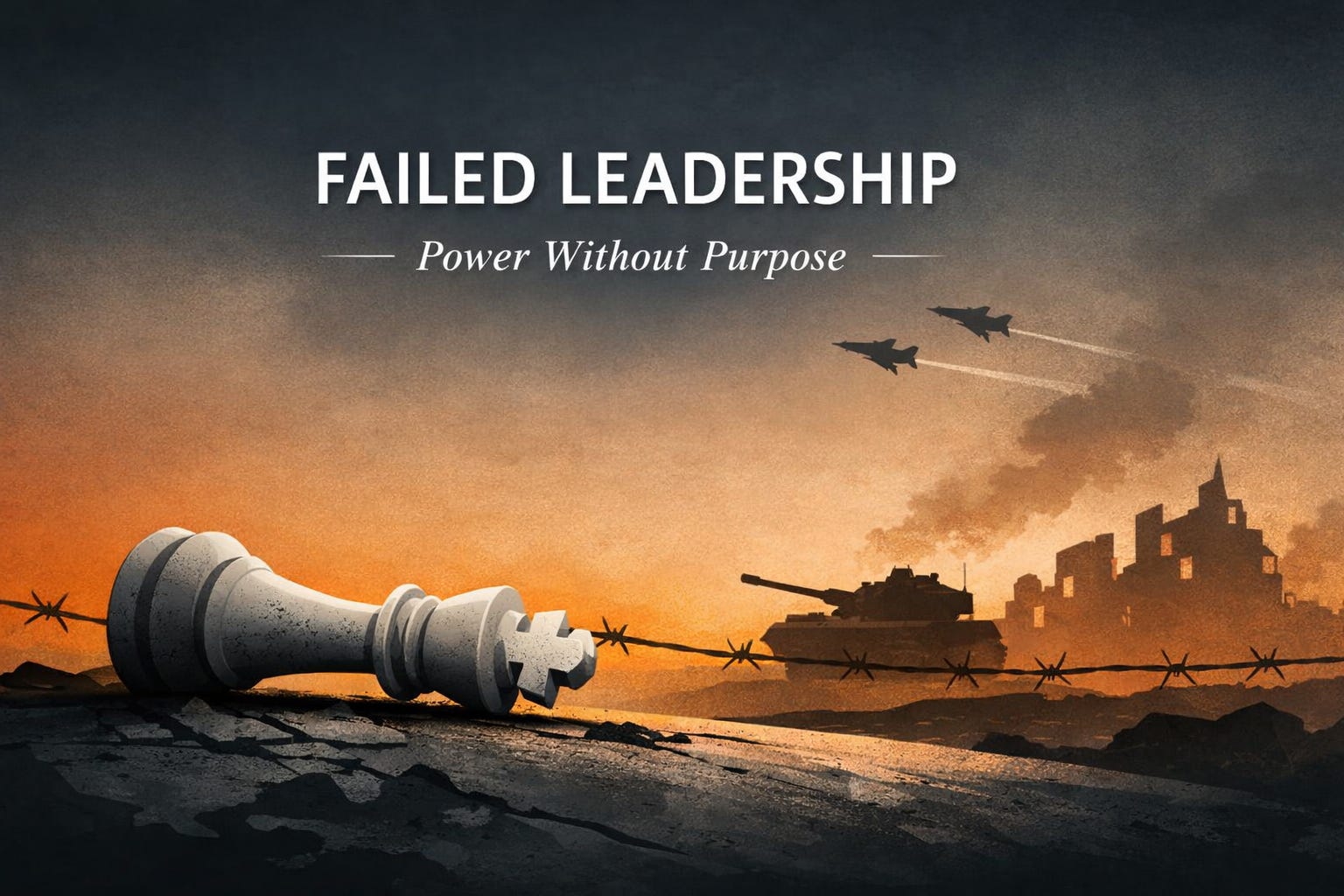
There are moments in history when leadership is not tested by complexity—but by clarity.
Moments when the right course of action is difficult, yet visible.
Moments when restraint requires more strength than escalation.
This is one of those moments.
And what we are witnessing is not simply a war.
It is a profound, unfolding case study in how not to lead.
The Collapse of Purpose
Leadership begins with purpose.
Not rhetoric.
Not projection.
Not force.
Purpose answers a fundamental question:
What outcome are we trying to achieve—and how do we get there?
When Donald Trump invoked “unconditional surrender” in relation to Iran, it projected certainty. It suggested control, dominance, and inevitability.
But leadership is not measured by the force of a declaration.
It is measured by the viability of the outcome it demands.
And here, the gap is immediate.
There is no credible pathway from current military actions to the unconditional surrender of a sovereign nation of over 93 million people.
As Lawrence Wilkerson has consistently warned, U.S. military engagements often suffer from a disconnect between tactical execution and the strategic end state.
This is not a strength.
It is direction without destination.
When Strategy Becomes Performance
One of the most dangerous failures in leadership is the substitution of performance for strategy.
Escalation appears decisive.
Movement appears productive.
But without alignment to reality, both are illusions.
Scott Ritter has argued that Iran’s defence posture is structured around endurance and deterrence—designed to absorb pressure and extend the cost of conflict.
Larry Johnson has similarly noted that wars driven by signalling rather than strategy drift into prolonged engagements without defined outcomes.
Research from the RAND Corporation and the Centre for Strategic and International Studies supports this pattern: conflicts involving resilient states rarely produce rapid, decisive outcomes.
This is what happens when leadership:
escalates without alignment
acts without defined objectives
substitutes messaging for planning
The result is not victory.
It is motion without meaning.
The Emergence of Stalemate
Stalemate is not declared. It reveals itself.
Through repetition without progress.
Through escalation without resolution.
Elijah Magnier has described this dynamic as a “war of endurance,” where survival—not victory—is the central objective.
This aligns with broader military analysis: when no decisive pathway exists, conflicts settle into prolonged stalemate or forced negotiation.
This is not a failure of force.
It is a failure of strategy.
A Senseless War: Violence Without Vision
At some point, the more profound question emerges:
Not how does this war end—
But why is it continuing at all?
Because this is no longer a war with a clear objective.
It is a war without a coherent purpose.
No defined, achievable end-state.
No alignment between military escalation and political resolution.
Only continuation.
Jeffrey Sachs has long argued that prolonged conflicts often reflect systemic failures—where power is exercised without accountability and consequences are externalized.
In such systems, war begins to serve different interests.
Defence sectors expand.
Weapons production accelerates.
Economic incentives align with instability.
A narrow set of actors benefits.
The global population absorbs the cost.
The Global Cost: A Leadership Failure Measured in Lives and Livelihoods
The consequences of this war are not confined to borders.
They ripple outward.
Energy prices rise.
Trade routes destabilize.
Supply chains fracture.
Data from the International Monetary Fund and World Bank show that geopolitical instability translates into inflation, reduced growth, and economic vulnerability across populations.
But the bigger risk is even more severe.
While failed leadership cycles between ceasefire, rearming, and renewed escalation—treating war as a sequence of tactical resets—the systemic risk continues to rise.
The risk of:
large-scale economic destabilization affecting billions
cascading regional escalation
widespread humanitarian crises
This is the ultimate leadership failure:
Treating war as manageable while its consequences become uncontrollable.
Who Benefits? The Structure Behind the Conflict
Data from Stockholm International Peace Research Institute shows that sustained conflict correlates with increased defence spending and arms production.
This does not define intent.
But it reveals structure.
A system in which:
Conflict drives profit
Instability sustains demand
Escalation fuels economic cycles for specific sectors
A small group benefits.
The majority pays.
The Failure of Global Leadership: Propaganda, Pretexts, and the Erosion of Truth
Before wars are fought, they are justified.
Through narrative.
Through repetition.
Through selective framing.
Patrick Henningsen has emphasized how modern information systems amplify specific narratives while limiting scrutiny.
Pretexts emerge—repeated widely, often without proportional evidence or challenge:
claims of necessary regime change
claims of urgent intervention to “save” populations
claims of existential threats requiring immediate escalation
Leadership requires discipline.
It requires evidence before action.
When narrative replaces truth, strategy collapses.
And when strategy collapses, leadership follows.
The Limits No Power Can Escape
No state—regardless of power—operates without limits.
Economic systems impose pressure.
Political systems impose consequences.
Reality imposes boundaries.
Mark Sleboda has observed that wars driven by maximalist objectives collapse under their own contradictions—not through victory, but through lack of sustainability.
Ceasefires emerge—not as success, but as necessity.
A Reflection
Imam Ali ibn Abi Talib teaches:
“The worth of a leader is measured by how they safeguard their people.”
The Leadership Lesson
This is not just a geopolitical crisis.
It is a leadership failure—clear, visible, and consequential.
A failure to define purpose.
A failure to align strategy with reality.
A failure to prioritize humanity over power.
And perhaps most critically:
A failure to recognize limits before those limits impose themselves.
Because leadership is not measured by escalation.
Not by dominance.
Not by the projection of strength.
It is measured by judgment.
By the ability to see clearly when others cannot.
By the discipline to act with intention, not impulse.
By the courage to choose restraint when escalation is easier.
What we are witnessing is what happens when power operates without these qualities.
And the lesson is unmistakable:
Power without purpose is not leadership.
It is the beginning of its own end.
References & Expert Context
This article draws on insights from experienced professionals across military, intelligence, economics, journalism, and geopolitical analysis. Their perspectives help illuminate the structural, strategic, and leadership dimensions of modern conflict.
Lawrence Wilkerson: Retired U.S. Army Colonel and senior policymaker, Wilkerson was directly involved in U.S. foreign policy during the Iraq War era. He is widely recognized for his critiques of strategic misalignment in U.S. military interventions, particularly the gap between tactical execution and long-term political objectives.
Scott Ritter: Former U.S. Marine Corps intelligence officer and UN weapons inspector in Iraq. Ritter specializes in arms control, military doctrine, and escalation analysis, often highlighting the limitations of conventional military approaches against resilient state actors.
Larry Johnson: Former intelligence officer and U.S. State Department official with a focus on counterterrorism and geopolitical risk. Johnson provides analysis on intelligence assessments, policy decision-making, and the strategic implications of U.S. foreign policy actions.
Elijah Magnier: Veteran war correspondent and geopolitical analyst with decades of reporting experience across the Middle East, including Lebanon, Iraq, and Syria. Known for his on-the-ground insights into asymmetric warfare and regional power dynamics.
Jeffrey Sachs: Globally recognized economist and Director of the Centre for Sustainable Development at Columbia University. Sachs has advised governments and international institutions and is known for his work on global development, economic systems, and the broader impacts of geopolitical conflict.
Patrick Henningsen: Geopolitical analyst and independent media founder focusing on information systems, media narratives, and Western foreign policy. His work explores how perception and narrative shape public understanding of conflict.
Mark Sleboda: Analyst specializing in military strategy, NATO dynamics, and multipolar global conflict. Sleboda provides insights into escalation patterns, strategic balance, and the structural limits of military power.
Institutional & Data Sources
RAND Corporation: A leading policy research institution providing analysis on military strategy, conflict dynamics, and long-term security planning.
Centre for Strategic and International Studies: A prominent bipartisan think tank offering research and policy analysis on global security, defence, and geopolitical trends.
International Monetary Fund: International financial institution providing data and analysis on global economic stability, inflation, and the macroeconomic impacts of geopolitical instability.
World Bank: Global development institution analyzing economic trends, poverty, and the systemic impacts of conflict on economies and societies.
Stockholm International Peace Research Institute: Independent research institute specializing in global security, military expenditure, and arms production trends.
Note on Perspective
The experts referenced herein represent a range of independent and institutional perspectives. Their insights are used to support analysis of:
leadership decision-making
strategic coherence
economic and systemic consequences of war
These references are intended to provide contextual depth and analytical grounding, rather than to attribute specific claims or direct quotations unless explicitly stated.